Is Hacoo Legit and Safe? What the App Is, How It Works and the Risks
What Hacoo is, who is behind it and why buying fake-brand items on the app can mean seizure and destruction at EU or Mexican customs, with no refund.
- 6 min
- 4 steps
- 6 questions
- 15 sources
Key facts
- What it is
- Content app with third-party sellers
- Company named in its terms
- None (governing law: United Kingdom)
- Google Play developer
- DOOP TECH LIMITED (Hong Kong)
- Trustpilot (Sep 29, 2026)
- 3.7 / 5 · 34% of reviews are 1 star
- EU customs (counterfeits)
- Seizure and possible destruction
- PayPal
- Doesn’t cover items that infringe trademarks
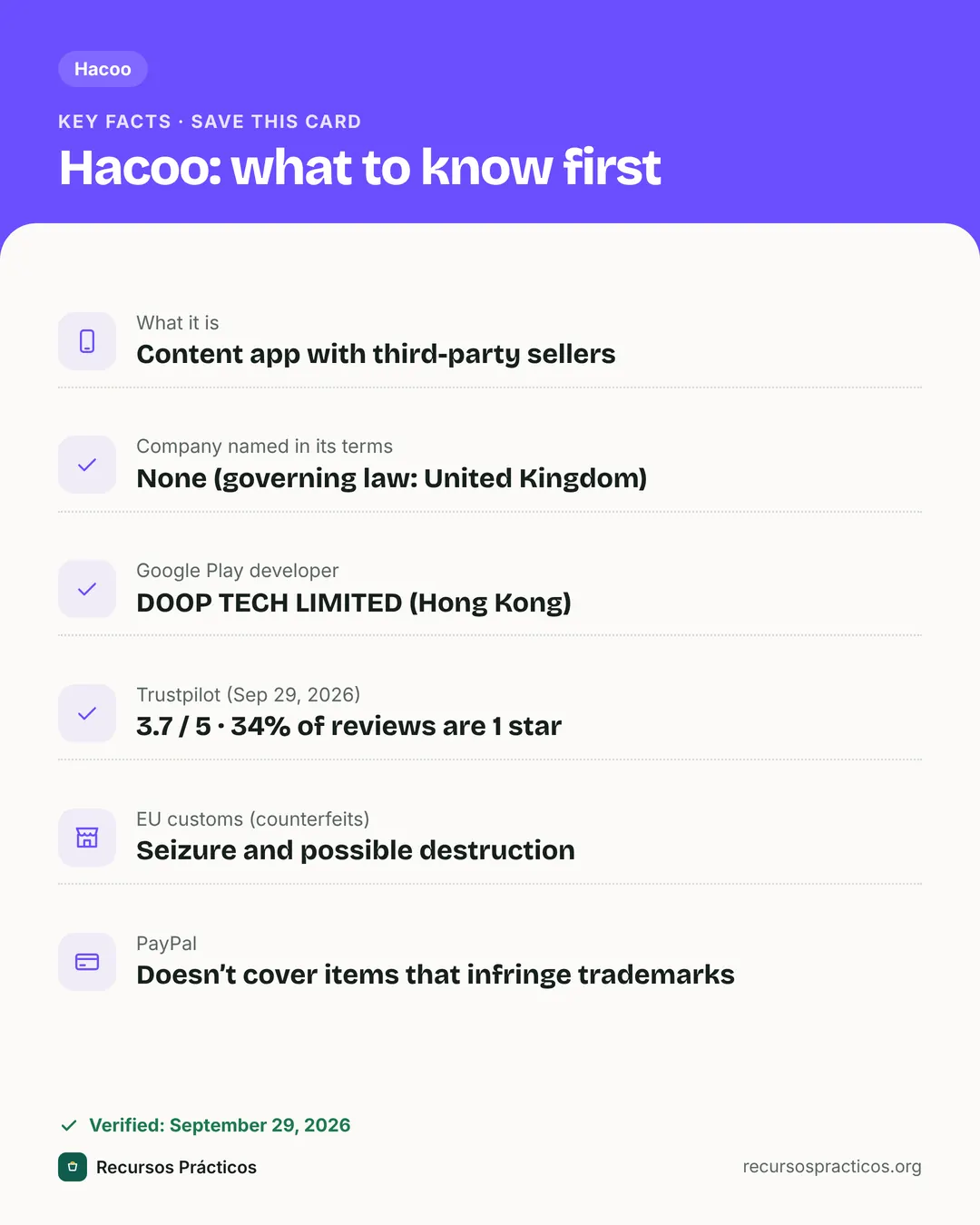 Download fact cardAn image with the key facts to save on your phone.
In this guide
Many people land on Hacoo through social media videos promising “brand-name” items at rock-bottom prices. Before buying, it helps to know what the app really is, who answers if something goes wrong, and what happens to a package of imitations when it crosses customs in Spain or Mexico.
Based on Hacoo’s terms, intellectual property policy and public pages; EU Regulation 608/2013 and the Spanish Tax Agency’s guidance; Mexico’s Federal Law for the Protection of Industrial Property; PayPal’s terms (Spain edition); and the press and legal sources cited at the end (accessed September 29, 2026). This guide is informational: we don’t link to sellers or explain how to get replicas.
What is Hacoo?
On its website, Hacoo describes itself as a “community-driven discovery ecosystem” and a social media platform. Its terms of service say it acts as an intermediary and that all content is posted by independent users and creators. They also add something important: the accuracy and authenticity of the content is each creator’s responsibility, not Hacoo’s.
Who is behind it: we haven’t found a reliable source that clearly identifies the company that runs Hacoo and that sells to or charges the buyer. This is what can be checked:
| Where | What it says |
|---|---|
| Terms of service at hacoo.app | No legal entity named. Governed by the laws of the United Kingdom. |
| Footer of Hacoo’s website | “New Kilmainham, Dublin 2, Ireland,” with no company name. |
| Google Play listing | Developer: DOOP TECH LIMITED, with an address in Hong Kong. Over 10 million downloads. |
| App Store listing (UAE) | Seller: Hacoo Tech Limited. |
Three different names or places and no company identified in the terms: if you have a serious problem with an order, it isn’t clear who to take it up with. Hacoo’s returns page also wasn’t publicly viewable when we checked (it returned an access error).
How does buying on Hacoo work?
In broad strokes, Hacoo works like a social storefront: you download the app, create an account and browse posts from creators and sellers showing products. Customer support is by in-app chat or email; its website doesn’t list a support phone number. We couldn’t find a public Hacoo page stating which payment methods it accepts or what its return conditions are.
According to an investigation by elDiario.es (February 2025), the app became popular for selling imitations of luxury brands. Officially, Hacoo’s intellectual property policy prohibits using other companies’ trademarks and lets brands request that such products be removed.
What happens at customs in Spain (EU) with a counterfeit?
The EU applies Regulation (EU) 608/2013. Customs authorities can seize goods suspected of infringing a trademark. For online purchases there is a specific procedure for small consignments:
| Step | What the rule says |
|---|---|
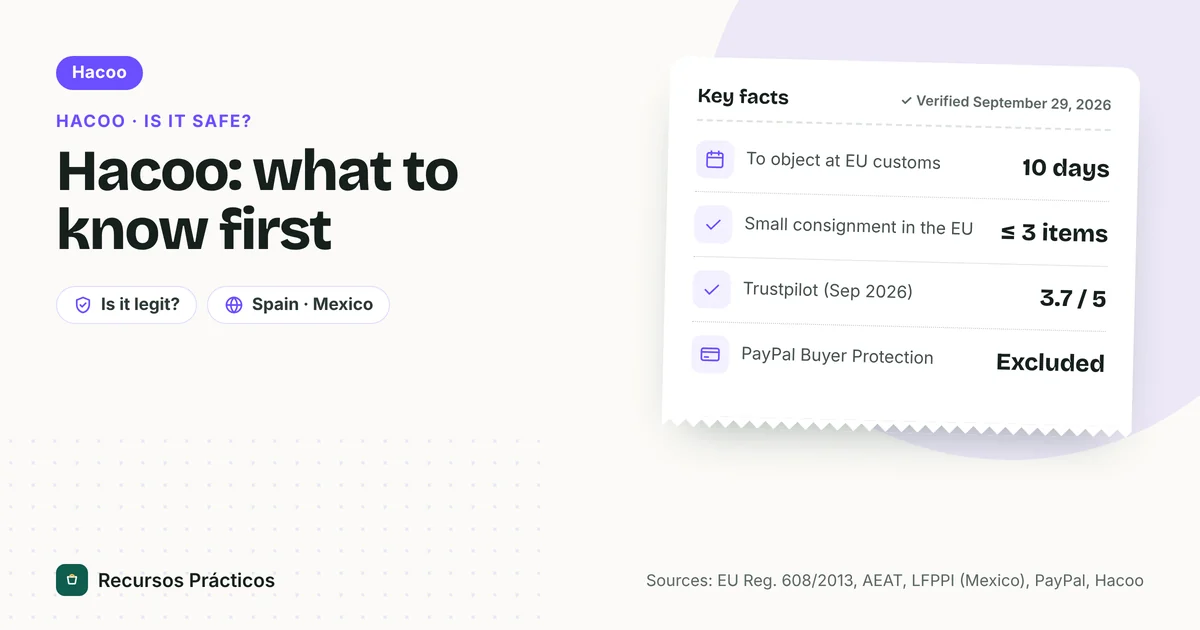
| What counts as a “small consignment” | A postal or courier package with 3 items or fewer, or with a gross weight under 2 kg. |
| Notice to the buyer | Customs notifies you of the seizure within 1 working day and says whether it plans to destroy the goods. |
| Your deadline to respond | 10 working days to agree to or object to destruction. |
| If you don’t respond | Customs may presume you agree to destruction. |
| If you object | Customs notifies the brand and may give it your name and address; the brand can start proceedings against you. |
The regulation only excludes non-commercial goods that travelers carry in their personal luggage; a package bought online doesn’t fall under that exception. Destruction takes place under customs supervision and, in practice, you lose both the product and the money you paid.
In addition, in Spain, selling counterfeit products is a crime under Article 274 of the Penal Code, as intellectual property law firms that have analyzed the Hacoo case point out. Reselling what you buy makes your situation worse.
And in Mexico?
The Federal Law for the Protection of Industrial Property (last amended in the DOF on April 3, 2026) allows the IMPI, in Article 344, to order the withdrawal from circulation of goods that infringe rights and to order the suspension of the free circulation of imported goods that violate the law, in accordance with customs rules. The IMPI and Mexico’s National Customs Agency (ANAM) have announced joint actions to protect intellectual property in foreign trade.
We haven’t found a statement from PROFECO (Mexico’s consumer protection agency) specifically about Hacoo. What is clear is that a package with items imitating a registered trademark can be held at customs and that, because this is an app with no company identified in Mexico, getting redress will be difficult.
Other risks: payments, quality and claims
- PayPal doesn’t protect you on these purchases. Its Acceptable Use Policy (Spain edition) prohibits using PayPal for items that infringe trademarks, and its Buyer Protection expressly excludes items prohibited under that policy.
- No safety guarantees. FACUA, a Spanish consumer group, warns that people buying on this platform can’t be sure the products meet all safety standards.
- Complaints are hard to pursue. According to FACUA, it is difficult to take action against a company based outside Spain and the EU; Hacoo’s terms, moreover, are governed by UK law.
- Sharply divided reviews. When we checked (September 29, 2026), Hacoo had 3.7 out of 5 on Trustpilot across 3,348 reviews: 51% five-star and 34% one-star. Recurring complaints involve refund problems, incomplete or damaged packages and blocked accounts.
Legal ways to save money
If you’re after a lower price, there are options where the company is identified and you have clear rights:
- Buy the original on sale or from the brand’s official outlets. It’s the only way to get the manufacturer’s warranty.
- Use marketplaces with a published return policy and an identified company. Check our guide on how to buy on AliExpress: it explains return windows, payment methods and what regulators say.
- Look for generic products, not imitations. A bag or sneakers with no logo and no design copying a brand greatly reduce the chance that customs holds them for this reason.
- Pay with a method that offers protection and keep screenshots of the listing, the payment and the tracking.

Verdict: is Hacoo legit?
Hacoo is a real app with millions of downloads, but it isn’t a safe place to shop: it doesn’t identify the company that sells, its returns policy isn’t public, and it is known for imitations, which can be held at customs (and, in the EU, destroyed) with nobody refunding your money. If you decide to use it, stick to low-value generic products and know that your protection is minimal.
FAQ
What is Hacoo?
An app that presents itself as a community for sharing content, where independent creators and sellers post products. Its terms say the authenticity of the content is the creators’ responsibility.
Who owns Hacoo?
It isn’t clear. Its terms don’t name any company; the website shows an address in Dublin, Google Play lists DOOP TECH LIMITED (Hong Kong) and the App Store lists Hacoo Tech Limited.
Can customs seize my Hacoo order?
Yes, if it contains items that imitate a brand. In the EU (Spain), customs notifies you and you have 10 working days to respond; if you don’t, it can destroy the package. In Mexico, the IMPI can order the suspension of the circulation of such imported goods.
If I pay with PayPal, can I get my money back for a replica?
Don’t count on it. PayPal’s Buyer Protection excludes items prohibited under its Acceptable Use Policy, which includes those that infringe trademarks.
Is it illegal to buy fakes on Hacoo?
In Spain, selling counterfeits is a crime (Article 274 of the Penal Code) and customs can destroy what you buy even if it’s for yourself. Reselling those items carries the most legal risk.
What’s a safer way to shop cheap?
Official sales and outlets, or marketplaces with an identified company and published returns, such as AliExpress, choosing generic products instead of imitations.
 Keep reading · AliExpress
Is AliExpress Legit and Safe? Buyer Protection, Scams, Fakes and US Duties
Read guide →
Keep reading · AliExpress
Is AliExpress Legit and Safe? Buyer Protection, Scams, Fakes and US Duties
Read guide →
Sources
- Hacoo — Terms of service
- Hacoo — About us
- Hacoo — Intellectual property protection
- Hacoo — Contact us
- Regulation (EU) 608/2013 (BOE, DOUE-L-2013-81294)
- Agencia Tributaria (Spain) — Customs intervention and destruction of goods procedure
- Cámara de Diputados (Mexico) — Federal Law for the Protection of Industrial Property
- PayPal Spain — Acceptable Use Policy
- PayPal Spain — Buyer Protection program
- Google Play — Hacoo
- App Store — Hacoo
- Trustpilot — Hacoo reviews
- elDiario.es — What is Hacoo (Feb. 2025)
- Ponti & Partners / ElDerecho — The Hacoo case and industrial property
- AHK LEX — Replicas on Hacoo: risks for consumers